
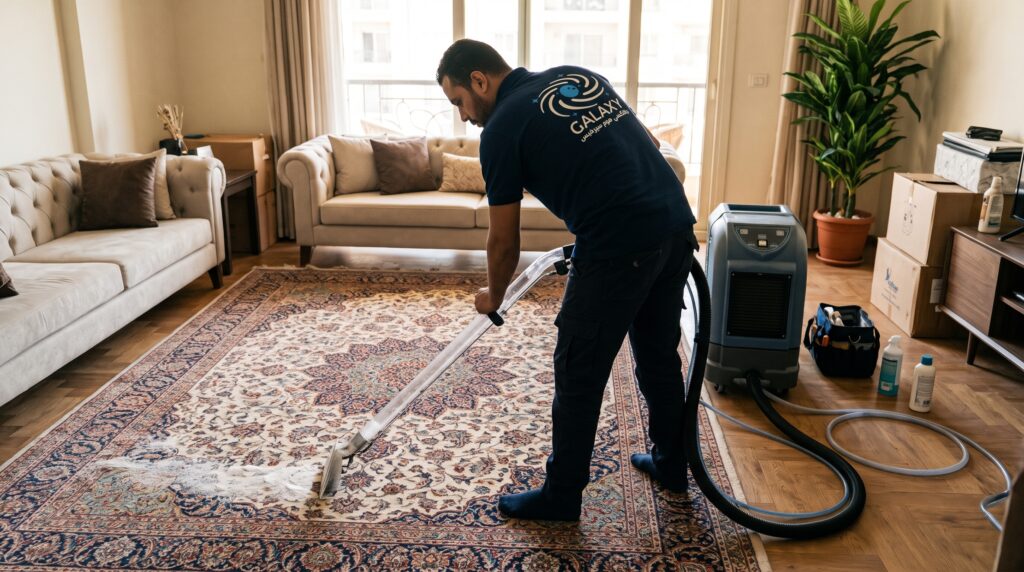
Hand-knotted Persian carpets—whether hailing from historic weaving master-houses in Isfahan, Tabriz, Kashan, Nain, or Qom—are world-renowned pinnacles of textile mastery. Woven over months or even years with knot densities exceeding hundreds of knots per square inch, these museum-grade heirlooms feature delicate kurk wool, hand-spun silk highlights, and intricate floral arabesques colored with ancient botanical dyes. In distinguished estates across Cairo and Giza, authentic Persian rugs represent prized family treasures and substantial artistic investments.
Yet, caring for an authentic Persian rug is fundamentally distinct from cleaning standard machine-made carpets. Persian rug foundations typically feature fine cotton or pure silk warps that are vulnerable to structural rot if water-soaked. Furthermore, natural dyestuffs—such as madder root, pomegranate rind, and indigo—are chemically sensitive to pH extremes. Using conventional alkaline carpet shampoos, aggressive mechanical rotating brushes, or steam cleaning will cause catastrophic dye migration, brittle warp snapping, and irreversible fiber burning.
This comprehensive conservation guide from the fine textile conservators at Galaxy Home Service breaks down the structural anatomy of Persian rugs, safe routine preservation protocols, emergency spill responses, and advanced non-destructive extraction procedures.
1. Anatomy of Fine Persian Carpets: Wool, Silk, and Botanical Pigments
Preserving an authentic Persian rug requires understanding the unique physical characteristics of its materials:
- Fine Kurk Wool & Lanolin Preservation: The finest Persian rugs utilize “kurk” wool—luxurious fleece combed from the neck and underbelly of yearling sheep. Rich in natural protective lanolin, kurk wool resists stains naturally. Using aggressive degreasers or hot steam dissolves this vital lanolin layer, leaving fibers coarse, brittle, and prone to rapid soiling.
- Pure Silk Warps and Highlights: Rugs from Nain, Qom, and Isfahan often incorporate pure mulberry silk within their outlines or entire foundation warps. Silk possesses high tensile strength but loses substantial structural stability when wet. Excessive heat or prolonged moisture weakens silk filaments, leading to permanent pile distortion.
- Natural Mineral & Botanical Dyes: Master weavers rely on natural mineral mordants and plant extracts to achieve rich turquoise, ruby, and saffron hues. These natural dyes are chemically volatile; exposure to alkaline detergents (pH > 8.0) breaks mordant bonds, triggering severe color bleeding (bleeding/run) into pristine ivory cream fields.
2. Best Practices for Daily and Weekly Preservation
Proper preventative care maintains the longevity and market value of antique and fine Persian floor pieces:
Suction-Only Vacuuming Architecture
- Strictly Avoid Motorized Beater Bars: Mechanical revolving roller brushes aggressively shred delicate hand-spun knots, snatch fine silk loops, and chew delicate fringe braids.
- Smooth Floor Head Attachments: Clean exclusively with suction-only smooth wand heads. Always glide the wand in the direction of the pile nap (the smooth grain of the wool), never against it.
- Fringe Preservation Protocol: Never run a vacuum nozzle over the fringes. Persian fringe threads represent the exposed structural skeleton of the warp. Vacuum along the rug perimeter, then gently hand-comb fringes using a soft-bristle brush.
Light Protection and Rotation
- Combating Selective Sun Fading: Egyptian sunlight carries intense UV rays that chemically break down vegetable pigments over time. Draw sheer solar curtains during peak afternoon hours and rotate the rug 180 degrees every six months to ensure even wear across high-traffic paths.
- Underlay Padding: Always install a dense, non-adhesive felt-and-rubber rug pad beneath the carpet. A quality pad prevents buckling, absorbs foot-impact compression, and protects foundation knots against ground shear against hard marble or porcelain tiles.
3. Emergency First-Aid for Spills on Persian Rugs
Accidental liquid spills require immediate, non-abrasive intervention:
- Blot Immediately (Zero Rubbing): Press thick stacks of clean, dry, unbleached white cotton towels firmly onto the spill zone. Rubbing or scrubbing abrades wet wool fibers and drives pigments deeper into foundation knots.
- Cold Water Dilution Only: Never apply warm or hot water, as heat accelerates dye migration and sets tannin stains. Lightly mist cold water onto a white cloth and blot repeatedly to dilute residual sugars or acids.
- Acidic pH Stabilization: For pet accidents, tea, or fruit spills, dab lightly with a solution of equal parts white distilled vinegar and cold water. Maintaining a slightly acidic environment (pH 4.5–5.0) locks botanical dyes in place and inhibits dye transfer.
- Elevate for Two-Sided Aeration: Elevate the treated zone on a low stand or upturned bowl with an electric fan directed across both the face and back. This ensures rapid drying and prevents moisture from stagnating inside dense cotton foundation warps.
4. Professional Non-Steam Foam Extraction for Persian Rugs
Commercial carpet cleaning machines, submersion wash pits, and thermal steam systems ruin fine Persian rugs. Safe restoration relies on low-moisture fluid mechanics and negative-pressure extraction:
- Gentle High-Volume Micro-Dusting: Before introducing any moisture, specialized pneumatic air extraction tools dislodge pounds of fine urban silica sand and micro-grit compacted deep within the base knots, without beating or damaging warps.
- pH-Calibrated Botanical Cleansers: Applying specialized lanolin-restoring, neutral-to-slightly-acidic cleaning solutions engineered specifically for fine wool and genuine silk, tested for colorfastness in an inconspicuous corner prior to full-surface application.
- Micro-Foam Encapsulation & Instant Extraction: Dense, dry-cleaning surfactant foam encapsulates suspended soil particles. A clear-head acrylic extraction wand immediately vacuums the encapsulated soil into a recovery tank under powerful negative pressure, removing over 90% of moisture in milliseconds while keeping the inner foundation dry.
- Hand Pile Aligning & Climate-Controlled Curing: Technicians hand-brush the pile following its natural directional grain and facilitate complete drying within 6 to 12 hours using directed, non-thermal ambient airflow.
5. Frequently Asked Questions (FAQ)
Can steam cleaning be used to sanitize antique Persian rugs?
No. High-temperature steam breaks down delicate kurk wool proteins, strips natural lanolin oils, melts pure silk highlights, and causes instant color bleeding among botanical dyes.
How can I tell if a Persian rug’s dyes will bleed?
Moisten a clean white cotton cloth with room-temperature water and press it firmly against each distinct color field for 30 seconds. If any trace of pigment transfers to the cloth, the dye is unstable and requires specialized chemical stabilization before any cleaning takes place.
How does Galaxy Home Service assess Persian rug cleaning services?
Pricing is evaluated based on exact square meters, knot density, fiber composition (pure kurk wool, wool-on-cotton, or pure silk), age, and whether localized dye bleeding from previous DIY attempts requires corrective stabilization. Clear photographs of the rug front and fringe knots allow our specialists to provide an exact evaluation.
Looking for certified, museum-grade care for your treasured Persian or Oriental masterpiece? Trust the specialized preservation team at Galaxy Home Service for safe, low-moisture deep extraction cleaning across Cairo and Giza.