
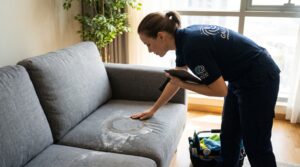
A premium fabric sofa is often the centerpiece of a home living room, representing both significant financial investment and daily family comfort. However, when accidental spills occur—whether coffee, tea, grease, or ink—many homeowners panic and reach for DIY cleaning hacks found online or whatever household chemical is under the kitchen sink.
Unfortunately, DIY upholstery cleaning causes far more irreversible furniture damage than the original stains themselves. In urban environments like Cairo and Giza, where fine desert dust settles deep into textile weaves, combining improper liquid cleaning methods with aggressive scrubbing frequently results in permanent water rings, fiber fraying, severe chemical discoloration, and internal mold growth.
This comprehensive guide from the fabric specialists at Galaxy Home Service breaks down the top catastrophic DIY upholstery cleaning mistakes, the science behind fabric damage, and how to safely handle emergencies before calling professionals.
1. The Top DIY Mistakes Ruining Living Room Sofas
Understanding the physical and chemical mechanics of upholstery fabrics helps you avoid costly errors:
Mistake 1: Soaking the Fabric with Excess Water (The Saturation Trap)
Upholstery is completely different from clothing. Beneath the exterior woven fabric lies multiple inches of dense polyurethane foam, dacron batting, springs, and wooden framing.
-
The Damage: When homeowners dump bowls of water or soapy solutions onto a stain, the water quickly sinks into the interior core. Standard household towels cannot extract deep moisture.
-
The Consequences: The trapped moisture causes musty, sour odors within 48 hours, rots internal wooden frames, rusts metal coil springs, and creates permanent brown water rings (cellulose browning) on the fabric surface as it slowly wicks back up.
Mistake 2: Aggressive Scrubbing with Stiff Brushes
When a dark spot appears, human instinct is to scrub vigorously with a brush or sponge.
-
The Damage: Rubbing breaks delicate woven yarns, causes synthetic fibers (like chenille and velvet) to mat and crush, and produces permanent surface “fuzzing” or pile distortion that can never be reversed.
-
The Rule: Never scrub upholstery. Always blot gently from the outside edge of the stain inward using a clean, dry, lint-free white microfiber towel.
Mistake 3: Using Chlorine Bleach, Vinegar, and Harsh Alkaline Detergents
Using multi-surface kitchen cleaners, dishwashing soaps, or chlorine bleach on colored upholstery destroys textile dyes.
-
The Chemical Impact: Chlorine bleach chemically strips color pigments, leaving yellow or white blotches. Highly alkaline dish detergents leave a sticky, soapy residue that fails to rinse out; this residue acts like a magnet, rapidly attracting everyday dirt and turning the cleaned spot black within weeks.
-
The Acidity Risk: Direct, undiluted vinegar or lemon juice can etch and degrade delicate fibers like viscose, linen, and silk.
Mistake 4: Ignoring the Manufacturer Cleaning Code Tag
Every upholstered sofa comes with a factory care tag hidden under the cushions or frame base. Ignoring this code is the fastest route to ruining your furniture:
-
Code W (Water-based): Can only be cleaned with gentle water-based foams and shampoos.
-
Code S (Solvent-based): Must be cleaned strictly with anhydrous dry-cleaning solvents. Applying water will shrink the fabric, melt backings, and cause permanent water stains.
-
Code W/S: Tolerates both water-based foam and mild solvent spot-treatments.
-
Code X: Vacuum and light brushing only; strictly no liquids or solvents permitted.
Mistake 5: Applying High Heat with Hair Dryers or Irons
Attempting to speed up drying using a hair dryer on high heat or pressing a domestic iron over a damp spot is disastrous.
-
The Result: Modern synthetic fabrics (polyester, nylon, olefin) melt or distort under high direct heat. Furthermore, heat permanently cooks protein-based stains (milk, blood, egg) directly into the yarn, making future removal impossible.
2. Emergency First-Aid: What You Should Do When a Spill Happens
If an accident occurs on your sofa, follow this safe, non-destructive initial protocol:
-
Act Instantly (Blot, Don’t Rub): Grab a stack of clean white paper towels or a dry white microfiber cloth. Press firmly against the spill to absorb maximum liquid before it penetrates the foam padding.
-
Scrape Semi-Solids: For food spills (sauces, chocolate), use the dull edge of a butter knife or spoon to lift off excess residue without driving it deeper into the fabric weave.
-
Dilute Cautiously (Mist, Don’t Pour): If necessary, lightly mist clean, room-temperature distilled water onto a white cloth (never directly onto the sofa) and gently blot to transfer remaining dye.
-
Accelerate Natural Airflow: Point a household electric fan or air mover directly at the damp cushion, and turn on the air conditioner to dehumidify the room quickly.
3. How Professional Non-Steam Foam Extraction Saves Damaged Upholstery
When household methods fail or stubborn stains persist, attempting further DIY experiments will only set the stain permanently. Professional restoration employs controlled physics and targeted chemistry:
-
Pre-Testing and Fiber Diagnostics: Specialists inspect the fiber type under magnification and test chemical stability in an inconspicuous spot before touching the visible seating area.
-
Deep Dry Particle Extraction: High-suction industrial vacuums strip dry sand and dust out of the fabric pores, preventing the formation of mud when liquids are introduced.
-
Targeted Neutralizing Emulsifiers: Customized pH-balanced agents break down lipid oils, tannins, and food greases at the molecular level without bleeding fiber dyes.
-
Industrial Foam Extraction: Specialized injection-extraction machinery forces active cleansing foam through the surface weave and immediately recovers over 90% of the liquid with high-vacuum lift, leaving the inner foam dry and preventing water rings.
4. Frequently Asked Questions (FAQ)
How can I remove a stubborn water ring left behind by a previous cleaning attempt?
Water rings are usually caused by uneven drying of mineral deposits or dissolved internal soils migrating to the surface. Fixing them requires equalizing the entire cushion surface with a controlled extraction rinse and rapid drying. Trying to spot-clean the ring with more water will only create a larger ring.
Can baking soda damage sofa fabric?
While baking soda is widely recommended online for absorbing odors, its micro-crystals are abrasive and alkaline. If left on the sofa or if moisture is added, it forms a crusty, chalky paste inside the fiber weave that standard domestic vacuums cannot extract, causing premature thread abrasion.
How are professional upholstery cleaning and stain removal services evaluated?
Quotes depend on the sofa size and seating configuration, fabric composition (chenille, linen, velvet, synthetic blends), the extent and age of the stains, and whether prior DIY chemical attempts need specialized corrective neutralization. Providing clear photos and details about the furniture allows technicians to determine the exact requirements.
Did a DIY cleaning attempt leave stains or water marks on your living room sofa? Contact the certified fabric care experts at Galaxy Home Service for safe, professional upholstery extraction across Cairo and Giza.