
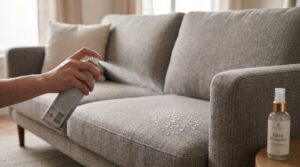
Investing in new upholstered furniture brings style and comfort to your home, but daily living introduces unavoidable hazards—spills, dust accumulation, pet accidents, and atmospheric particulate matter. In major urban centers across the Greater Cairo and Giza metropolitan areas, fine desert dust combined with everyday spills quickly degrades unprotected fabrics.
Applying a high-grade fabric protector spray establishes a micro-barrier across your upholstery fibers. This guide details how fabric protection chemistry works, step-by-step application protocols, fabric-specific precautions, and common pitfalls to ensure your furniture remains pristine for years.
1. How Fabric Protectors Actually Work (The Science of Repellency)
Fabric protectants rely on fluoropolymers or advanced silicone- and silane-based polymers. When cured onto the textile fibers, these formulations dramatically lower the surface energy of the yarn below the surface tension of common liquids.
-
Liquid Beading vs. Absorption: On unprotected cellulose (cotton, linen) or synthetic fibers, liquid immediately penetrates through capillary action. A treated surface forces liquids (coffee, juice, oil, water) to bead into spherical droplets on the outer surface tension, providing a generous window to blot them away before staining occurs.
-
Dry Soil Resistance: Beyond liquids, protector barriers prevent microscopic dust and particulate debris from embedding deeply into the fiber weave, making weekly vacuuming significantly more effective.
-
Fiber Flexibility: High-quality formulations coat individual fibers without stiffening the weave, preserving the natural tactile softness and breathability of luxury sofas.
2. Fabric Compatibility: Deciding Which Textiles to Spray
Before spraying any product, you must verify the furniture manufacturer’s cleaning code on the care tag:
-
Code “W” (Water-Based Cleaners Safe): Ideal for water-based polymer protectants. Excellent for synthetic velvets, polyester, and performance blends.
-
Code “S” (Solvent-Based Cleaners Only): Requires solvent-based aerosol protectors. Applying water-based formulas to “S” fabrics can cause permanent water rings and localized shrinkage.
-
Code “W/S” or “SW”: Compatible with both water- and solvent-based protector sprays.
-
Code “X” (Vacuum or Brush Only): Do not apply fabric protector sprays. These delicate textiles (rare silks, untreated antiques) require specialized dry extraction only.
3. Pre-Application Preparation Checklist
A protector applied over existing dust or hidden grime simply locks that soil into the weave permanently. Proper surface preparation is essential:
-
Thorough High-Suction Dry Vacuuming: Utilize a clean upholstery tool and crevice attachment to remove all dry debris, grit, and airborne particulate settling from seams and beneath seat cushions.
-
Spot Testing for Colorfastness: Always spray a concealed patch (such as the underside of a back cushion or bottom dust cover). Wait 15 minutes, then press a clean white microfiber towel against the spot. If color transfers or the texture alters, do not proceed.
-
Environmental Ventilation: Ensure ambient airflow by opening adjacent windows or operating cross-ventilation fans. Avoid direct harsh sunlight during application to prevent premature flash-drying.
4. Step-by-Step Professional Application Protocol
Achieving uniform protective coverage without saturation requires measured, controlled technique:
Step 1: Distance and Sweep
Hold the spray nozzle approximately 15 to 20 cm (6 to 8 inches) away from the fabric surface. Depress the valve fully and apply using a steady, overlapping side-to-side sweeping motion.
Step 2: The Two-Coat Cross-Hatch Technique
Avoid heavy drenching. The gold standard in upholstery protection is applying two uniform, light coats:
-
First Pass: Apply horizontally across the entire piece.
-
Second Pass: Allow 30 to 45 minutes of partial drying, then apply vertically at a 90-degree angle. This ensures full coverage across every facet of the woven fibers.
Step 3: High-Contact Reinforcement
Give slight extra attention to high-wear contact zones: the front bullnose of seat cushions, armrest caps, and headrest positions where skin sebum and friction are highest.
Step 4: Curing and Drying Timeline
-
Initial Dry to Touch: 2 to 4 hours under normal room temperature (22°C to 26°C).
-
Full Polymer Cure: 24 to 48 hours. Avoid sitting on or placing decorative throws on the furniture until complete molecular cross-linking is achieved.
5. Maintenance: How to Clean a Protected Sofa
A treated fabric is stain-resistant, not stain-proof. When a spill happens, follow this protocol to maintain the integrity of the barrier:
-
Blot, Never Scrub: Immediately place an uncolored, absorbent microfiber towel directly over the pooled liquid. Allow capillary action to draw the moisture up into the towel. Aggressive rubbing forces the liquid past the protective shield into the core yarn.
-
Gentle pH-Neutral Cleaning: For residue left behind, mist lightly with lukewarm water mixed with a mild, pH-neutral surfactant. Never use alkaline household bleach or caustic detergents, as high alkalinity strips protective coatings instantly.
-
Reapplication Schedules: Friction from daily use gradually wears down the coating on seat cushions and armrests. Reapply the protector spray every 6 to 12 months, or immediately following an intensive professional hot water extraction.
6. Frequently Asked Questions (FAQ)
Does fabric protector change the texture, color, or breathability of upholstery?
High-grade modern fluoropolymer and silane protectors do not alter the hand-feel, shade, or airflow of the textile once fully cured. Lower-grade heavy wax or silicone sealants, however, can cause slight stiffening, which is why professional-grade formulations are recommended.
How often should fabric protector be reapplied?
For residential living room furniture used daily by families, reapplication every 6 to 12 months is ideal. For formal guest salons with minimal usage, protection can remain effective for up to 2 years.
Can fabric protector sprays be applied to leather?
No. Standard fabric sprays are formulated for porous, woven textile yarns. Leather requires dedicated pH-balanced conditioning creams and specialized water-repellent polymers designed to nourish hide without clogging pores.
What factors dictate the cost and requirements for professional furniture care?
Upholstery protection and deep cleaning criteria depend on several technical variables: the overall seating capacity and dimensions (sectional vs. standard multi-seater units), fabric construction (chenille, linen, synthetic microfiber, or velvet), and whether pre-cleaning or extraction is required prior to applying protection. Accurate assessments are provided following a visual inspection of the furniture items.
Looking for comprehensive care? If your furniture requires intensive soil extraction prior to barrier treatment, explore our specialized Deep Upholstery & Sofa Cleaning Services across Cairo and Giza.