
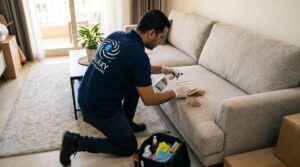
A quality fabric sofa is the centerpiece of everyday comfort in homes across Cairo and Giza. Yet, it is constantly exposed to accidental mishaps: spilled black coffee, dark tea, grease from food, children’s ink markers, or muddy pet paws.
When a spill occurs, human panic usually leads to aggressive rubbing, pouring water, or drenching the cushion with harsh dish soaps or bleach. Unfortunately, improper cleaning methods cause far more irreversible harm than the initial stain itself. The results are often distorted fabric piles, faded patches, cellulosic water rings, and deep mildew within internal cushions.
This practical guide from the textile care specialists at Galaxy Home Service breaks down the chemistry of sofa stains, safe emergency treatments for common spills, and the non-destructive methods needed to protect delicate living room upholstery.
1. The Core Golden Rules of Fabric Spot Treatment
Before applying any liquid to a stain, commit to these three fundamental principles:
-
Always Blot, Never Scrub: Rubbing creates friction that frays delicate yarn loops, crushes velvets, and drives liquid deeper into the inner polyurethane foam. Always use a clean, dry, lint-free white microfiber towel, pressing firmly from the outside edge toward the center.
-
Read the Care Tag (The Universal Fabric Codes): Look beneath seat cushions or under the frame skirt:
-
W: Cleanable with water-based foam solutions only.
-
S: Dry-cleaning solvents only (water will leave permanent rings).
-
W/S: Safe with either mild water-based foams or solvents.
-
X: Vacuum and soft brush only; strictly no liquid detergents.
-
-
Always Spot-Test First: Test any solution on a hidden area (such as the back panel or lower hem) to confirm dye stability before treating visible cushions.
2. Targeted Solutions for the Most Common Household Stains
Different stains have distinct molecular compositions. Matching the correct solution to the stain type prevents permanent chemical setting:
A. Coffee and Black Tea (Tannin Stains)
-
The Mechanism: Coffee and tea contain natural plant tannins that bond quickly to cotton and linen fibers.
-
Safe Protocol: Blot up all liquid immediately. Lightly mist a mild solution of lukewarm water and a drop of neutral surfactant onto a white cloth. Blot from the edges inward. Avoid hot water, which sets tannin dyes permanently.
B. Cooking Oils, Butter, and Food Grease (Lipid Stains)
-
The Mechanism: Lipids coat fibers with an oily film that repels plain water and attracts ambient dust.
-
Safe Protocol: Sprinkle talcum powder, cornstarch, or baking soda over the fresh grease spot. Let it sit for 20 minutes to absorb surface oils, then vacuum it away with a clean nozzle. Dab lightly with a cloth dampened with a specialized mild solvent or diluted neutral degreaser to lift remaining oil.
C. Ballpoint Ink and Marker Stains
-
The Mechanism: Inks are pigment-rich solvents that bleed and spread rapidly when combined with excessive moisture.
-
Safe Protocol: Dampen a cotton swab with 70% isopropyl alcohol. Lightly dab the ink lines without spreading outward. Rotate to clean cotton swabs repeatedly as ink transfers. Never pour alcohol directly onto the fabric.
D. Chocolate, Sauces, and Organic Spills
-
Safe Protocol: Gently lift away solid crusts using the dull edge of a spoon or plastic card. Blot remaining residue with a clean damp cloth, avoiding saturation into the underlying foam padding.
3. Why Professional Non-Steam Foam Extraction Outperforms DIY Hacks
While minor spots can be blotted early, large or aged stains require balanced physics and calibrated suction rather than chemical guessing:
-
Eliminating Water Rings: Water rings occur when cleaning water dissolves internal dust and slowly migrates to the outer surface during uneven drying. Professional extraction machines remove over 90% of moisture immediately, preventing ring formation.
-
Protecting Fiber Structure: Unlike harsh household scrubbing brushes, professional technicians use ultra-soft horsehair grooming brushes and low-moisture active foam that traps dirt particles without fraying woven yarn.
-
Deep Sanitization Without Saturation: Professional injection-extraction flushes out dissolved grime and immediately vacuums it into an external recovery tank, leaving the core foam dry and preventing mold or sour odors.
4. Emergency Action vs. Common Mistakes
| Action | Recommended Professional Method | Harmful DIY Mistake |
| Immediate Response | Firm blotting with clean white towels | Vigorous circular rubbing with a colored rag |
| Drying | Ambient room airflow or gentle fan (6–12 hrs) | Blasting high heat with a hair dryer or iron |
| Cleaning Agent | pH-neutral, fabric-specific solutions | Pouring chlorine bleach or caustic dish soap |
| Water Quantity | Controlled mist on cloth only | Dumping bowls of soapy water directly onto cushions |
5. Frequently Asked Questions (FAQ)
Can baking soda damage my sofa fabric?
Yes, if used incorrectly. Baking soda micro-crystals are abrasive and alkaline. If combined with liquid or left unextracted, they form a crusty, chalky paste inside the fiber weave that standard household vacuums cannot fully remove, causing premature thread friction and discoloration.
How soon will my fabric sofa be completely dry after professional extraction?
Because professional high-vacuum extraction removes almost all water instantly, fabric upholstery dries completely within 6 to 12 hours under normal ambient room ventilation.
How is the cost of professional upholstery stain removal determined?
Pricing depends on the sofa configuration, fabric type (chenille, velvet, linen, or synthetic weaves), the age and severity of the stains, and whether prior DIY chemical attempts require specialized neutralization. Sending clear photos of the sofa allows technicians to provide an accurate assessment.
Facing a stubborn stain on your favorite living room sofa? Trust the fabric care specialists at Galaxy Home Service for safe, restorative deep foam extraction across Cairo and Giza.